



TYPBTK Chapter 08 Syllabus Based Guide
64.18.2 Describe the distinguishing features of aviation turbine fuel (AVTUR/Jet A-1)
AVTUR is the general name for aviation turbine fuel. The most commonly used grade in New Zealand is Jet A-1. In the United States, Jet A is common.
Turbine fuel:
* Is a kerosene-type fuel.
* Consists mainly of liquid hydrocarbons containing hydrogen and carbon.
* Has relatively low volatility compared with AVGAS.
* Has a relatively high flash point.
* Has a specific gravity of 0.80.
* Provides high heat energy by volume.
* Can absorb and retain small quantities of water.
* May contain wax and other contaminants.
* Can support microbiological growth when water is present.
* Must remain capable of flowing at very low temperatures.
* Provides some lubrication to fuel-system components.
* Is formulated to resist deterioration during storage.
* Must atomise and vaporise sufficiently for reliable ignition and efficient combustion.
* Presents less of a fire hazard than AVGAS because of its lower volatility, although it remains a dangerous combustible fuel.
An ideal turbine fuel should:
* Flow easily, including at very low temperatures.
* Ignite readily during ground starts and airborne relights.
* Burn efficiently under all operating conditions.
* Have the highest practical calorific value.
* Avoid harming the combustion and turbine sections.
* Avoid corroding the fuel system.
* Provide adequate lubrication.
* Present the lowest practical fire hazard.
* Resist icing and microbiological contamination.
The flow properties of AVTUR depend upon its viscosity. As the fuel becomes colder, its viscosity increases and it becomes more difficult to pump and atomise.
Its ignition performance depends particularly upon:
* Its volatility, meaning its ability to vaporise.
* Its degree of atomisation, which depends upon viscosity, fuel pressure and nozzle design.
Although AVTUR is not as easy to ignite as AVGAS or MOGAS, it can still be dangerously combustible.
64.18.4 Compare AVTUR and AVGAS and describe methods of preventing misfuelling
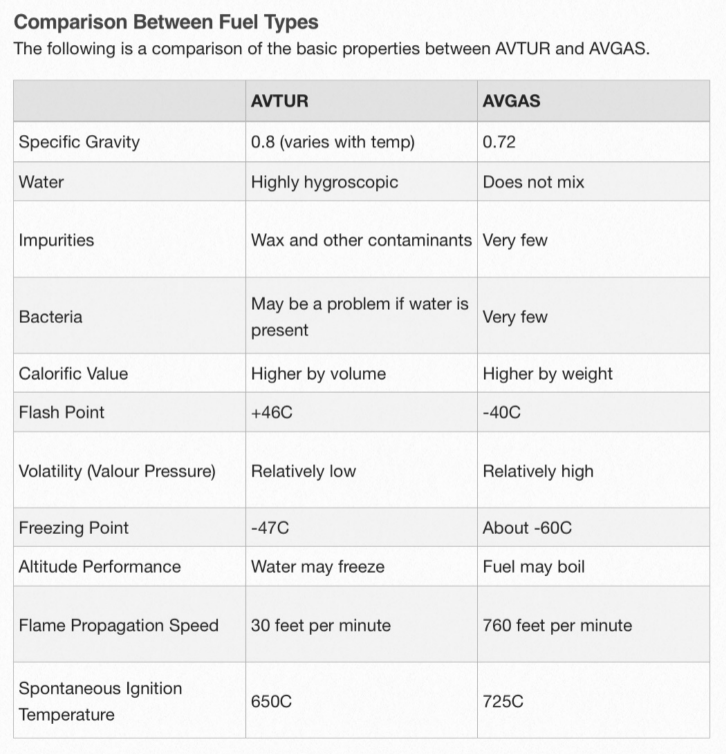
AVGAS
* Vaporises more readily.
* Is easier to ignite.
* Has a much lower flash point.
* Presents a greater handling fire hazard.
* Is more likely to boil and cause vapour-related problems at altitude.
* Has a lower specific gravity.
AVTUR
* Is less volatile.
* Has a higher flash point.
* Can hold dissolved or suspended water.
* May suffer water icing and waxing problems.
* May support microorganisms if free water is present.
* Has a higher specific gravity.
Some turbine engines may be permitted to operate temporarily on AVGAS or another emergency fuel, but only when authorised by the aircraft flight manual. However, possible consequences include:
* Changes in fuel-control operation because of different specific gravity.
* Increased engine RPM.
* A need to reduce the thrust-lever setting to remain within RPM limits.
* Greater carbon formation.
* Higher flame temperature.
* Higher combustion chamber and turbine metal temperatures.
* Reduced combustion chamber and turbine component life.
* Additional operating restrictions.
* Required maintenance following its use.
The ability of a turbine engine to burn a fuel does not mean that the fuel is approved for normal use.
A conventional reciprocating (piston) engine designed for AVGAS must not be operated on AVTUR. This form of misfuelling can have devastating consequences.
Methods of reducing misfuelling
* Clearly labelling the required fuel.
* Using different colours for the fuels.
* Using different colours or markings on fuel tankers.
* Differentiating hoses and delivery equipment.
* Using different fuel nozzles.
* Making AVTUR delivery nozzles too large to fit the fuel tank openings of many reciprocating engine aircraft.
* Checking the aircraft’s required fuel before refuelling.
* Remaining present and attentive during refuelling.
These precautions reduce the likelihood of error but do not eliminate the need for pilot and refueller vigilance.
64.18.6 State the differences between turbine fuel types and identify their common usage names
AVTUR is the general term for aviation turbine fuel. Within what is defined as AVTUR, there are different types of fuels.
Jet A-1
* The most commonly encountered international turbine fuel.
* Specified freezing point of approximately -47°C.
* In the United States it carries the designations JP-5 and the military designation F-35.
Jet A
* Commonly available particularly in the United States.
* Slightly different from Jet A-1.
* Specified freezing point of approximately -40°C.
* In the United States it carries the designations JP-4 and the military designation F-40.
Aircraft flight manuals specify:
* The fuel approved for normal operation.
* Any approved alternative fuels.
* Any emergency fuels.
* Associated operating limitations.
* Required maintenance following emergency-fuel use.
A turbine engine may physically run for a short time on fuels such as:
* AVGAS
* MOGAS
* Diesel
* Kerosene
* Natural gas
* Other combustible substances
This does not make their use automatically safe or approved.
The main concerns when changing fuel include:
* Specific gravity
* Volatility
* Fuel-control calibration
* Engine RPM
* Flame temperature
* Carbon deposits
* Metal temperature
* Component life
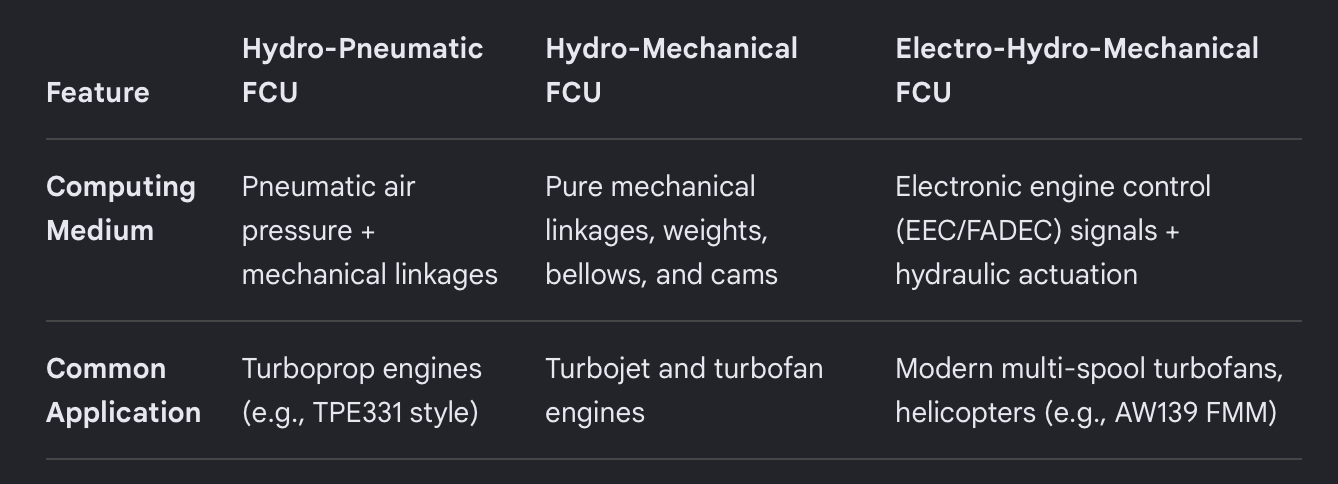
64.18.8 Describe the functions of turbine engine fuel system components (a) Fuel control unit (hydro-pneumatic, hydro-mechanical and electro-hydro-mechanical)
The pilot selects the required thrust using:
* The thrust lever; or
* The autothrottle.
The required thrust is produced by controlling how much fuel reaches the combustion chamber.
When the thrust lever is advanced:
1. The fuel control increases fuel flow.
2. Fuel pressure at the spray nozzles increases.
3. More fuel enters the combustion chamber.
4. Gas temperature and energy increase.
5. The engine accelerates.
6. Engine RPM and total gas flow increase.
7. Thrust increases.
The fuel control unit must do considerably more than act as a valve. It must schedule the correct fuel flow while compensating for:
* Airspeed
* Altitude
* Air density
* Ambient temperature
* Engine RPM
* Engine acceleration and deceleration
* Gas temperature
* Engine operating limits
Automatic fuel control can involve:
* Pressure control, particularly in turboprops.
* Flow control.
* Combined acceleration and speed control.
* Pressure ratio control.
* Electronic engine control.
EEC
An EEC (Electronic Engine Control) monitors engine performance and makes control inputs to keep important parameters within safe limits. It monitors the RPM of the separate engine spools, and the gas temperature. A limiter type EEC intervenes when a limit is approached. It signals the fuel flow regulator or fuel metering unit to reduce fuel flow and maintain a safe spool RPM, or gas temperature.
A supervisory EEC uses aircraft and atmospheric data. It helps the pilot select an appropriate thrust, it makes small automatic adjustments and maintains the commanded thrust as operating conditions change.
FADEC and FAFC
FADEC (Full Authority Digital Engine Control) takes over nearly all steady state and transient engine control decisions.
A FADEC controlled fuel system may be reduced mainly to:
* A fuel pump.
* A fuel-metering device.
* An independent shut off valve.
* Protective features for electronic failure.
FAFC (Full Authority Fuel Control) provides complete electronic control of the fuel system but does not have all the transient control intelligence used by FADEC to coordinate other engine functions, such as compressor airflow control.
64.18.8 Describe the functions of turbine engine fuel system components (b) Fuel heater
Fuel heating is normally provided by a fuel-oil heat exchanger.
Its two main functions are:
1. To warm the fuel.
2. To cool the engine oil.
Hot engine oil transfers heat to the colder fuel.
Warming the fuel
* Reduces fuel viscosity.
* Improves fuel flow.
* Helps prevent water-ice accumulation.
* Reduces the risk of blocked filters and small fuel system orifices.
Cooling the oil
This helps keep the lubrication system within its permitted temperature range. The fuel-oil heat exchanger is commonly located between the fuel booster pumps and the fuel filter inlet. Fuel heating and FSII (explained below) may both be used to alleviate water icing problems.
64.18.8 Describe the functions of turbine engine fuel system components (c) Governors and limiting devices
Governors and limiting devices prevent the engine from exceeding safe operating values.
In a turboprop:
* Engine RPM and propeller pitch both influence power.
* Fuel flow and propeller pitch must be coordinated.
* The throttle and propeller controls are interconnected to maintain the correct relationship between airflow and fuel flow.
* Maximum engine RPM is normally restricted by the propeller speed controller.
* A fuel governor limits fuel supply to prevent engine overspeed.
Electronic limiting systems monitor parameters such as spool RPM and gas as temperature. When a limit is approached, the system can command the fuel low regulator or fuel metering unit to reduce fuel flow. A supervisory electronic system also makes small corrections so that thrust remains consistent with the pilot’s demand despite atmospheric changes.
FADEC provides more comprehensive protection by controlling both steady state and changing operating conditions.
64.18.8 Describe the functions of turbine engine fuel system components (d) Engine driven fuel pumps
Low pressure booster pumps in the aircraft tanks supply fuel to the engines.
The engine driven high pressure pump then:
* Accepts fuel from the low pressure system.
* Raises its pressure to several hundred psi or more.
* Supplies high pressure fuel for fuel operated servo functions.
* Supplies the fuel control or metering unit.
* Provides the pressure required at the spray nozzles.
There are 2 main types of fuel pump, the gear-type and plunger-type.
A gear-type pump:
* Is a positive displacement pump.
* Produces output broadly proportional to engine RPM.
* Is relatively light.
* Supplies more fuel than the engine normally consumes.
Plunger-type pump contains:
* A rotating cylinder block or rotor.
* Several plungers.
* An angled, non-rotating cam plate.
As the cylinder block rotates, the cam plate causes the plungers to move backwards and forwards.
Plunger-type pump output depends upon:
* Engine RPM.
* Cam-plate angle.
* Plunger stroke.
A fuel servo changes cam plate inclination and therefore changes pump delivery.
A plunger pump may:
* Deliver approximately 100-2,000 gallons per hour.
* Produce approximately 2,000 psi.
* Absorb as much as approximately 60 horsepower during normal operation.
Excess fuel
The high pressure pump delivers more fuel than the engine requires. This allows the FCU/FMU to meter the necessary quantity accurately. The excess fuel is returned upstream through a spill valve, usually to the system before the low pressure filter.
Fuel also lubricates the engine driven fuel pump.
Dump valve
Following shutdown, a dump valve may drain fuel from the manifold so it does not enter the combustion chamber. This reduces the likelihood of excessive residual fuel causing a wet start during the next engine start.
64.18.10 State the ideal fuel/air ratio for a turbine engine
As mentioned on Page 100 (Combustion Section), the ideal air/fuel ratio is 15:1. Note this is 15 parts air to 1 part fuel, not the other way around. The syllabus has worded it as the ‘ideal fuel/air ratio’ which would technically be written as 1:15.
64.18.12 Describe the following properties in relation to turbine engine fuels (a) Specific gravity
Specific gravity indicates the density of a liquid compared with water. AVGAS has a specific gravity of 0.72, while Jet A-1 has a specific gravity of approximately 0.80. This means one litre of Jet A-1 weighs approximately 0.80 kgs. Specific gravity varies with temperature. Therefore the fuel temperature affects the mass of fuel that can be loaded into a tank with a fixed volume.
AVTUR provides a slightly higher heat value by volume (per litre) than AVGAS because AVTUR has the higher specific gravity. AVGAS provides a slightly higher heat value by weight (per kilogram).
Specific gravity is discussed further below.
64.18.12 Describe the following properties in relation to turbine engine fuels (b) Fire hazard
AVTUR has:
* Lower volatility than AVGAS.
* Lower vapour pressure.
* A higher flash point.
* A much slower flame propagation speed.
These features make it less readily ignitable than AVGAS.
Nevertheless, it is important to note that:
* AVTUR is combustible.
* Fuel vapour can ignite.
* Handling and storage precautions must be observed.
* Spillage, heat and ignition sources remain serious hazards.
AVGAS presents the greater immediate ignition risk because it vaporises readily and has a much lower flash point.
64.18.12 Describe the following properties in relation to turbine engine fuels (c) Fuel icing
Fuel icing is normally caused by water contained in the fuel.
Water may exist as:
1. Dissolved water: held at molecular level in the fuel.
2. Entrained water: suspended as very small droplets.
3. Free water: collected as larger droplets or puddles.
As fuel cools, it can no longer retain as much dissolved water. Water comes out of solution and becomes entrained or free water. At approximately -1°C to -3°C, entrained water may begin forming ice crystals. These crystals can:
* Remain suspended in the fuel.
* Collect on filters.
* Block filters.
* Block small passages and orifices.
At approximately -18°C (the critical icing temperature), crystals start adhering more readily to surfaces and to one another.
Fuel icing must be distinguished from fuel freezing or waxing:
* Fuel icing: water within the fuel freezes.
* Fuel waxing/freezing: components of the fuel itself form wax crystals.
Fuel icing can be controlled using:
* Fuel heating.
* Fuel-oil heat exchangers.
* FSII (Fuel System Icing Inhibitors)
* Regular removal of free water.
* Fuel-system sumping.
* Water-scavenge systems.
64.18.14 State the effect of a change in specific gravity on fuel weight
Specific gravity determines how much a given volume of fuel weighs.
For the same volume:
* Higher specific gravity means greater fuel weight.
* Lower specific gravity means lower fuel weight.
Therefore, if two tanks both contain 1000 litres:
* Fuel with an SG of 0.80 weighs approximately 800 kg.
* Fuel with an SG of 0.72 weighs approximately 720 kg.
Specific gravity changes with temperature. Consequently, the temperature of fuel being loaded affects how much fuel mass can fit into a tank of fixed volume. A change of fuel type can also affect the fuel control because the same volume of a lower density fuel contains less mass. Changing from AVTUR to AVGAS may affect:
* Fuel control operation.
* The RPM governor.
* Maximum engine RPM.
* Required thrust lever position.
64.18.16 Describe the purposes of anti-icing and microbiocidal additives
Anti-icing additive
Fuel System Icing Inhibitor (FSII) is added to reduce the likelihood of water ice forming in the fuel system. FSII:
* Acts on undissolved water, including entrained and free water.
* Is approximately 500 times more soluble in water than in fuel.
* Migrates from the fuel into water droplets when they form.
* Lowers the freezing point of the water.
* Can prevent water ice formation down to approximately -40°C.
The resulting mixture of water and FSII may:
* Pass through and be consumed by the engine; or
* Be removed from the fuel tank sumps.
FSII is not commonly used in all commercial air transport aircraft but has been used extensively in military aircraft. It may serve as an alternative to fuel heating in some smaller business jet aircraft.
FSII treats only the water in the fuel (helping to prevent water-ice only), it does not prevent the fuel itself from reaching its specified freezing or waxing temperature.
Microbiocidal additives
Microorganisms can grow at the boundary between fuel and free water. These organisms are commonly described as fungus.
Selected microbiocidal additives are used to reduce:
* Microbiological growth.
* Sludge formation.
* Suspended solid matter.
* Fuel-pump wear.
* Corrosion.
* The possibility of fuel system blockage.
Biocides support contamination control but do not remove the need for good storage, inspection and water drainage.
64.18.18 Describe the susceptibility of turbine fuel to water contamination
AVTUR is more susceptible than AVGAS to holding water.
Minute quantities of water can exist in AVTUR as:
* Dissolved water.
* Entrained water.
* Free water.
Even if water were completely removed during refining, the fuel could reabsorb water from atmospheric moisture (condensation within the tank).
Water can enter the aircraft fuel system through:
* Refuelling.
* Contaminated fuel supplies.
* Humid air entering through tank vents.
* Condensation inside the tanks.
* Poor storage practices.
Consequently, aircraft fuel tanks cannot be kept completely free of all water.
As fuel cools:
1. Its ability to hold dissolved water decreases.
2. Water comes out of solution.
3. It becomes entrained water.
4. It may form free water or freeze into ice crystals.
Free water also allows microbiological contamination to develop and contributes to corrosion. The practical operational objective is therefore to keep undissolved water to the lowest possible level.
64.18.20 Describe methods of detecting fuel system contamination
Fuel sampling and sumping
Water settles at low points because it is denser than turbine fuel. Fuel is drained from tank sumps and low points so that a sample can be checked for:
* Free water.
* Sediment.
* Solid contamination.
* Abnormal colour or appearance.
* Microbiological material.
Checks before fuel is loaded
Fuel should be inspected and checked before being loaded onto the aircraft to verify that free water and unacceptable contamination have been removed.
Routine tank-water drains
Regular draining provides a means of detecting water in the fuel and removing it.
Filter and separator inspection
Contamination may also be revealed through inspection of:
* Fuel filters.
* Fuel/water separators.
* Storage system filters.
* Aircraft fuel system filters.
Visual evidence of microbiological growth
Microbiological contamination may appear as:
* Sludge.
* Dark or discoloured material.
* Suspended solids.
* Deposits collected in samples or filters.
64.18.22 Explain precautions used to avoid contamination by water and other impurities
Before refuelling
* Obtain fuel from a controlled and reputable source.
* Ensure the correct storage procedures have been followed.
* Check fuel quality before loading.
* Use suitable fuel/water separators.
* Use appropriate filters.
* Confirm that free water has been removed.
During refuelling
* Prevent dirt and foreign material from entering open fuel connections.
* Use clean refuelling equipment.
* Avoid introducing contaminated fuel.
* Ensure tanks, hoses and dispensing equipment are correctly maintained.
* Confirm the correct fuel grade.
In the aircraft
* Drain fuel tank sumps regularly.
* Drain low and stagnant points in the fuel system.
* Follow the specified water-drain procedure.
* Use water scavenge systems where installed.
* Keep fuel filters serviceable.
* Use fuel heating where provided.
* Use FSII when required and approved.
* Monitor fuel temperature to avoid icing and waxing conditions.
Storage and maintenance
* Use good fuel storage procedures.
* Prevent unnecessary exposure to moisture.
* Drain accumulated water from storage tanks.
* Inspect and maintain filters and fuel/water separators.
* Conduct regular aircraft tank-water drains.
* Use approved microbiocidal additives where necessary.
* Investigate evidence of fungus, sludge or corrosion.
* Maintain clean tanks, pumps and fuel system components.
Keeping the fuel free of undissolved water reduces three major hazards; fuel system icing, microbiological growth and corrosion.